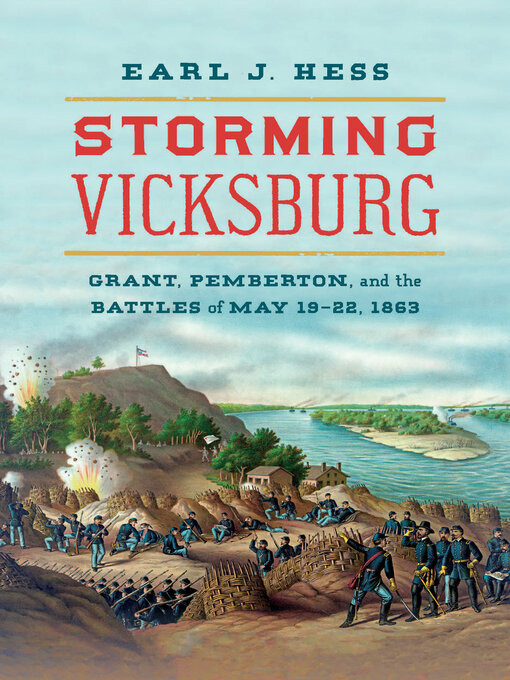
The most overlooked phase of the Union campaign to capture Vicksburg, Mississippi, was the time period from May 18 to May 25, 1863, when Ulysses S. Grant closed in on the city and attempted to storm its defenses. Federal forces mounted a limited attack on May 19 and failed to break through Confederate lines. After two days of preparation, Grant’s forces mounted a much larger assault. Although the Army of the Tennessee had defeated Confederates under John C. Pemberton at Champion Hill on May 16 and Big Black River on May 17, the defenders yet again repelled Grant’s May 22 attack. The Gibraltar of the Confederacy would not fall until a six-week siege ended with Confederate surrender on July 4.
In Storming Vicksburg, military historian Earl J. Hess reveals how a combination of rugged terrain, poor coordination, and low battlefield morale among Union troops influenced the result of the largest attack mounted by Grant’s Army of the Tennessee. Using definitive research in unpublished personal accounts and other underutilized archives, Hess makes clear that events of May 19–22 were crucial to the Vicksburg campaign’s outcome and shed important light on Grant’s generalship, Confederate defensive strategy, and the experience of common soldiers as an influence on battlefield outcomes.
- Just Added Comics and Graphic Novels
- New Additions!
- Manga
- Marvel Comics
- Classics in Comics Form
- POW!!!! Banned and Challenged Comic Books
- See all ebooks collections
- No wait, no problems
- What's new?
- New teen additions
- Popular titles
- Check these out!
- Listen Against Prejudice
- YALSA Amazing Audiobooks
- See all audiobooks collections
