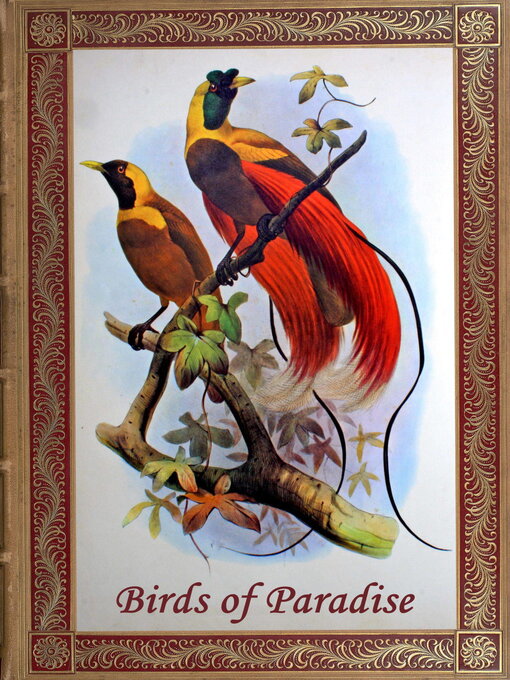
75 delightful color drawings detailing ornithological species. The drawings executed by Mr. Wolf and W. Hart will receive the admiration of those who see them; for, like all these artists's productions, they cannot be surpassed, if equalled, at the present time.
Among the many and diversified ornithological groups of which we have any knowledge, there is none that contains species possessing a more extraordinary and abnormal style of plumage than that in which are included the beautiful creatures universally known as Birds of Paradise. The lands they inhabit, even at the present day, are classed among those with which the civilized world is least acquainted, and which have always, by means of their dense forests, rugged surface, unhealthy climate, as well as the hostility of their native tribes, presented insuperable obstacles to successful exploration by the naturalist, however ardent and adventurous, who sought to discover their hidden treasures. It is not surprising, therefore, that many and absurdly exaggerated stories have always been current regarding the Birds of Paradise ; and the announcement that they lived in the air, and hatched their eggs under their wings, obtained many believers, notwithstanding the acknowledged difficulty of these achievements, particularly the last.
For many years the Birds of Paradise have been known to all persons whose avocations called them to the Moluccas ; and the earlier voyagers among those islands entertained strange views regarding these attractive creatures. Their beautiful plumage excited the admiration of the most indifferent person ; and the strange stories related of them aroused the fears of the more superstitious of even the reckless mariners. The Malay traders gave them the name of " Manuk dewata," or " God's birds ; " and the Portuguese, finding them without feet or wings, and not being able to learn any thing authentic about them, called them " Passaros do Sol," or "birds of the sun;" while the learned Dutchmen who wrote in Latin, called them "Avis paradiseus," or "Paradise-bird." John Van Linschoten gives these names in 1598, and states that no one has seen these birds alive ; for they live in the air, always turning towards the sun, and never alighting on the earth until they die ; for he says that they have neither feet nor wings, as may be seen by the birds carried to India, and sometimes to Holland.
The Great Bird of Paradise is very active and vigorous, and seems to be in constant motion all day long. It is very abundant, small flocks of females and young males being constantly met with; and though the full-plumaged birds are less plentiful, their loud cries, which are heard daily, show that they also are very numerous. Their note is ' Wawk-wawk-wawk wok-wok-wok,' and is so loud and shrill as to be heard a great distance, and to form the most prominent and characteristic animal sound in the Aru Islands. The mode of nidification is unknown; but the natives told me that the nest was formed of leaves placed on an Ant's nest, or on some projecting limb of a very lofty tree ; and they believe that it contains only one young bird. The egg is quite unknown; the natives declare that they have never seen it ; and a very high reward offered for one by a Dutch official did not meet with success.